Latest Digital Marketing Trends in 2026: How AI, SEO and Social Media Are Changing Online Marketing
Introduction
Have you ever wondered why some businesses grow quickly online while others struggle to get noticed? One major reason is how they use digital marketing.
The online world is changing every day. A few years ago, businesses mainly focused on websites, Google rankings, and social media posts. Today, things are quite different. Artificial Intelligence (AI), changing search habits, short-form videos, and personalized content are creating new opportunities for businesses.
In 2026, digital marketing is not just about promoting products or services. It’s about understanding what people want, giving them useful information, and building a connection with them.
Let’s take a closer look at the digital marketing trends that are making a difference this year.
1. AI Is Becoming a Helpful Partner for Marketers
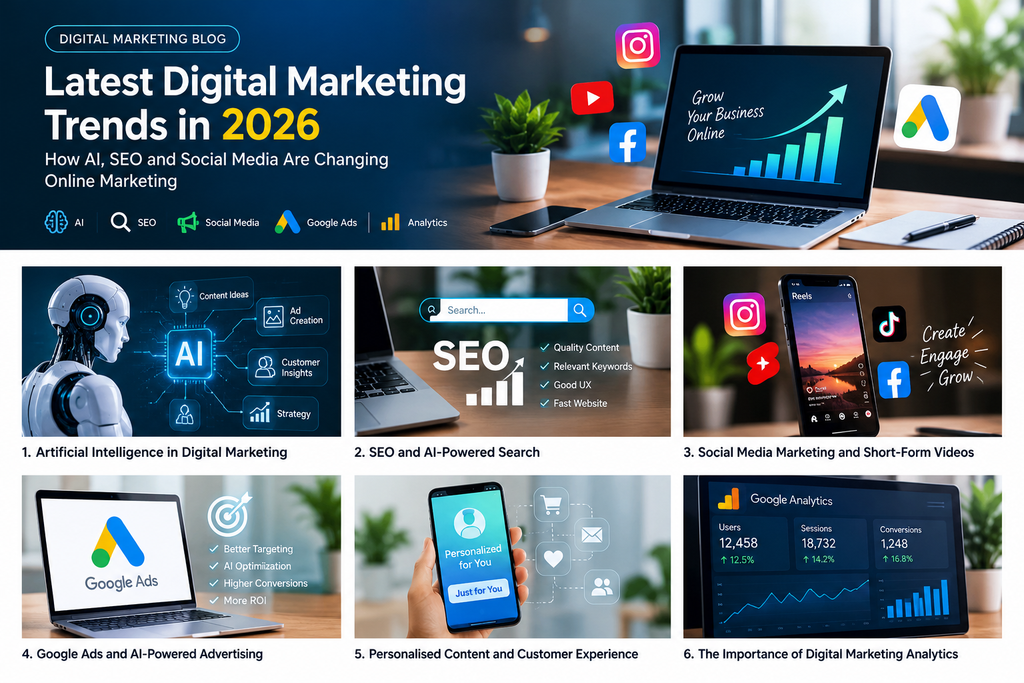
Artificial Intelligence has quickly become part of everyday digital marketing. From writing content to analysing campaign performance, AI tools are helping marketers complete many tasks more easily.
For example, imagine you’re managing the social media account of a small business. Instead of spending hours thinking about content ideas, you can use AI tools to find inspiration, prepare captions, and plan your content calendar.
AI can help with:
- Finding fresh content ideas.
- Understanding customer behaviour.
- Creating marketing content.
- Analysing advertising results.
- Improving customer support through chatbots.
But here’s something important: AI cannot understand every customer the way a real person can. It can provide suggestions, but human creativity, experience, and personal understanding still matter.
The smartest approach is to use AI as a supporting tool rather than depending on it for everything.
2. SEO Is Changing Along With the Way People Search
SEO has always been an important part of digital marketing. Businesses want their websites to appear when potential customers search for their products or services.
But have you noticed how people search online today?
Instead of typing just two or three words, people often ask complete questions. They also use AI-powered search experiences to find information and recommendations.
Because of this, SEO is becoming more focused on providing helpful answers rather than simply adding keywords to a webpage.
Some important areas to focus on include:
- Creating original and useful content.
- Understanding what users are actually searching for.
- Improving website speed and mobile experience.
- Building website authority and trust.
- Making content easy for both people and search engines to understand.
SEO is not just about getting more visitors. It’s about attracting the right people who are genuinely interested in what a business offers.
3. Social Media Is About More Than Just Posting
Most businesses have social media accounts, but simply posting regularly doesn’t guarantee results.
People scroll through hundreds of posts every day. So, what makes them stop and pay attention?
Usually, it’s content that feels interesting, useful, entertaining, or relatable.
In 2026, businesses are focusing more on:
- Instagram Reels and YouTube Shorts.
- Behind-the-scenes content.
- Customer reviews and experiences.
- Influencer collaborations.
- Educational and informative posts.
For example, a small clothing store doesn’t always need expensive advertisements. It can attract attention by sharing styling tips, showing new arrivals, or posting videos of customers enjoying their products.
The main idea is simple: people connect with people, not just brands.
4. Short-Form Videos Are Winning Attention
Let’s be honest. Most people don’t have the patience to watch long promotional videos, especially when they are scrolling through social media.
That’s one reason short-form videos have become so popular.
Instagram Reels, YouTube Shorts, and similar video formats allow businesses to share their message quickly and creatively.
A restaurant can show how its food is prepared. A travel company can share beautiful destinations. A digital marketer can explain a useful marketing tip in just 30 seconds.
You don’t always need expensive cameras or professional editing. Sometimes, a simple video with a good idea can get more attention than a highly produced advertisement.
What matters most is grabbing attention and giving viewers something worth watching.
5. Customers Expect More Personalised Experiences
Think about your own online shopping experience. Have you ever noticed a product recommendation that matches something you recently searched for?
That’s an example of personalised marketing.
People are more likely to engage with brands that understand their interests instead of showing them the same advertisements again and again.
Businesses are using customer data and marketing tools to provide more relevant experiences through:
- Personalised email campaigns.
- Product recommendations.
- Targeted advertisements.
- Relevant offers and promotions.
- Customer-specific communication.
When customers feel understood, they are more likely to develop trust in a brand.
However, businesses should always respect customer privacy and use personal data responsibly.
6. Voice Search and AI Search Are Changing Online Discovery
Searching online is becoming more conversational.
Earlier, someone might type “best restaurant Malappuram” into Google. Now, they might ask, “Which is a good restaurant for family dining in Malappuram?”
This change is encouraging businesses to create content that answers real questions in a natural way.
Voice assistants and AI-powered search experiences are also influencing how people discover information.
Businesses can prepare by:
- Adding frequently asked questions to their websites.
- Using clear and natural language.
- Providing accurate business information.
- Creating content that directly answers customer questions.
The goal is to make it easier for people to find useful information about your business.
7. Data Is Helping Marketers Make Better Decisions
One of the biggest mistakes in digital marketing is making decisions based only on assumptions.
A social media post might receive hundreds of likes, but does that mean it is bringing customers to the business?
This is where data becomes important.
Tools like Google Analytics and Google Search Console help marketers understand website traffic, visitor behaviour, and search performance.
By checking the results, marketers can identify:
- Which pages attract more visitors.
- Where website traffic comes from.
- Which keywords bring visitors.
- How users interact with a website.
- Which marketing campaigns perform better.
Instead of spending money without knowing the results, businesses can use this information to improve their marketing strategies.
Conclusion
Digital marketing in 2026 is bringing many new opportunities for businesses. AI is helping marketers work smarter, SEO is adapting to changing search behaviour, and social media is creating new ways for brands to connect with people.
But one thing hasn’t changed: understanding customers is still the foundation of good marketing.
You can use the latest AI tools, follow every SEO update, and post regularly on social media. But without useful content and a clear understanding of your audience, getting meaningful results can be difficult.
My advice to businesses is simple: don’t follow every trend just because it’s popular. Understand your audience, choose the strategies that suit your business, and focus on building genuine relationships with customers.
Because at the end of the day, successful digital marketing is not just about being visible online. It’s about making people remember your brand and giving them a reason to choose you.